Showing posts with label science fraud. Show all posts

Monday, 15 April 2024

Science Fraud by Mike Sutton, Discount Code for 40% Off the Retail Price


 To get a 40% discount on the price of  Science Fraud, the book, available from Curtis Press. Go to Curtis Press and simply use the code suttonsites24 for a 40% discount on this book.


Friday, 13 January 2023

The Darwin Fraud

 The Darwin Myth is bust by newly discovered empirical data 

You have been misled by those who pretend to themselves and to others that they are scientists, historians and proper academic scholars.


Friday, 31 December 2021

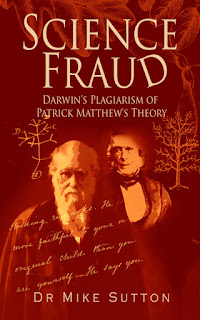
Science Fraud

 The cover of my forthcoming book is actually green. 

If you see a red cover then you almost certainly have the red mist of anger. Perhaps you are angry at the fact you have been duped all these years by the Darwin Industry? Or perhaps you are one of the Darwinite horde suffering from new data hater syndrome?  

There is only one cure. Buy my book and be inoculated against lies and other total nonsense about Charles' Darwin's genius originality. He was little more than a serial lying apex plagiarist. 

This book relies entirely on what Professor Michael Streven's calls the "Iron Rule" of science, namely empirical facts, and new BigData unearthed ones at that, to prove beyond all reasonable doubt that Charles Darwin and Alfred Wallace plagiarised the theory of evolution by natural selection from Patrick Matthew.

PRE-ORDER from the science publisher Curtis Press NOW to secure a first edition copy. 

Science Fraud: Darwin’s Plagiarism of Patrick Matthew’s Theory by Mike Sutton.

"Science Fraud" reveals how malicious New Data hater Darwin superfans and others, facilitated by members of the Darwin Industry, have committed repeat research plagiarism, tried multiple times without success to have the author fired from a senior academic position, and spread misinformation via Wikipedia and elsewhere in an attempt to re-bury the cast iron bombshell New Data on Darwin's and Wallace's plagiarism and associated lies. 

PUBLICATION DATE 12 FEBRUARY 2022 - INTERNATIONAL DARWIN DAY!


.

Wednesday, 2 August 2017

Uncovering the Most Sensational Science Fraud Since Piltdown Man


.
The world's leading experts (including Charles Darwin, Alfred Wallace and Richard Dawkins) agree that Patrick Matthew, not Darwin or Wallace, originated the full theory of evolution by natural selection. However, Darwin convinced the world that neither he nor any other naturalist had read it before he and Wallace replicated it and claimed it as their own. Darwin told several lies about the scientific readership of Mathew's book. Independently verifiable facts in this book prove it. Darwin's lies concealed what he had twice been told in writing about the pre-1858 readership of Patrick Matthew's prior-published theory. This discovery of Darwin's proven sly dishonesty, added to Sutton's original bombshell discovery of the "New Data" that several highly influential naturalists, who Darwin and Wallace knew, in fact did read and then cite Matthew's (1831) book containing his original breakthrough before Darwin and Wallace (1858) and Darwin (1859) replicated it without citing Matthew, uncovers the world's most sensational case of plagiarising science fraud by glory theft. The Latin phrase "Nullius in Verba" has been the motto of Britain’s famous Royal Society – one of the oldest learned societies in the world – since the 17th century. It means that we should not accept that something is true based solely on anyone’s word regardless of his or her authority or stature. Sutton has brought his considerable expertise in understanding what causes crimes of intellectual and property theft to the area of scientific discovery theft. He has unearthed compelling new evidence of the Royal Society’s egregious failure to faithfully follow its own oldest and most fundamental tenet resulting in the greatest scientific fraud in history. Just as new DNA analysis is changing traditional forensic science, Sutton has pioneered the use of newly available "big data" analysis of the literature to expose science fraud. His biggest catch so far, Charles Darwin – the same Charles Darwin credited with discovering the theory of natural selection. In his book "Nullius in Verba: Darwin’s Greatest Secret," Sutton reveals in compelling and convincing detail a huge cache of independently verifiable facts that, contrary to what is said in an untold number of documentaries, books and scholarly works, the theory of macroevolution by natural selection was not independently discovered by Charles Darwin, or Alfred Wallace. Avoiding any religious and philosophical entanglements, Sutton’s sharp objective eye of the criminal investigator and academic creates a vivid and authentic depiction of the times, the characters, and the cover-up that endured for over 130 years – until now. More than the clues and facts, Sutton brings to life the colorful personalities, professional rivalries, gargantuan egos, and scramble for notoriety and its riches of the people involved. This behind-the-scenes portrayal will be fascinating to anyone who loves a true-life detective story, where in this case, the victim was the truth. It will be very surprising if Darwin’s claim to have independently discovered the theory of natural selection will survive Sutton’s tireless investigative research and fact-driven discovery paradigm puncturing evidence. (Available on all Amazon sites e.g Amazon.com and Amazon.uk).

Sunday, 19 April 2015

The Google Monster Sniffed-out the Darwin --> Robert Mudie Connection to Patrick Matthew

The Google Monster

image
Dysology.orgAttribution
The Google (1913)
My original work in discovering the links between David Low and Robert Mudie to Patrick Matthew's (1831) Original prior-published discovery of the 'natural process of selection' and Darwin's replication of it would not have been possible without Google Chrome and the ID research method, which enabled me to search through over 30 million books and journals.
So effective is the ID research method that it enabled me to get back further with the Google search engine than Google's own staff - where I used the Google Monster to sniff out its namesake.
In fact, I used Google to discover the original Google! You can read that amusing story about the power of ID here.

Into the forests of the 19th century with Google to find evidence of Darwin's plagiarism

In the year I was born, Loren Eiseley caused a stir in 1959 when he accused Charles Darwin of plagiarizing the work of Edward Blyth (see Smith 1979    for an interesting but somewhat disingenuous overview of Eisleley's collected works of 1979, where Smith, in the general and unfortuantely biased fashion of so many typical desperate dysological Darwinists gives the dismissive false impression - deliberate or just remiss - that it is he who has discovered that Blyth took much from Mudie's 1835 "Feathered Tribes" book, when in fact Eiseley (1979, e.g, page 61) labored the point and it is from him that Smith gets it - so long as you bother to read Eiseley carefully.. The difference between Blyth and Smith is that Blyth was careful to cite his sources. The difference between Blyth and Darwin is just the same! The difference between Eiseley and Smith is that Eiseley was careful to cite his sources. The difference between Eiseley and Darwin the same.
Eiseley's collected papers on the topic of Darwin's plagiarism of Blyth can be found in the Book that contains those collected papers on Darwin. namely, Darwin and the Mysterious Mr X   , which was published in 1979, two years after Eiseley's death.
image
Edward Blyth is acknowledge to have Influenced Darwin. His most influential papers were edited by Loudon, who had earlier - in 1832 - reviewed Matthew's (1831) book and said it might have something original to say on "the origin of species"! Darwin's associate William Hooker (father of Darwin's best friend) knew Loudon and his friends very well!
Loren Eiseley (1979) ably demonstrated (pp 61-62) that Darwin cumulatively borrowed from Blyth's (1835) book 'The feathered tribes of the British islands' and his other published papers, without citing them.
Much of Darwin's prose, it was ably demonstrated by Eiseley, came from Blyth's papers of 1835 and 1837. But it is true also that nothing much of the full hypothesis of natural selection comes from them (see Smith 1979   ); although they are important papers on variety and habitat etc. But when it comes to his 1837 paper on to topic of "variation" and the "localizing principle" -    (published by Longman and co - Matthew's London publisher - no less) - Eiseley (1979, p. 91) explains that Blyth comes close to the theory on natural selection. On this point, Eiseley- points out the work of De Beer which shows how much Blyth influenced Darwin's writing in his private Zoonomianotebook of 1837-38. What De Beer and Eiseley failed to note is that Blyth's "localizing principle" is heavily dependent upon Matthew's bombshell observations six years earlier of "power of occupancy".
In particular, we must remember that the religious Blyth did not believe in the evolution of species and pulled back form where his prose was leading-back to Matthew's conclusions that species could vary so much that they became new species. See Eiseley (1979 p.58 for an explanation of this fact). And that is a key point about the limitations of stopping at Blyth, as Eiselely did, and of not going back from him to Matthew - who originated and wrote out the entire theory of natural selection and was cited many times and reviewed by Blyth's editor - John Loudon and with whom we can establish collegiate links with Blyth's friend Mudie and others (as explained in great detail in Nullius   ) and particularly Mudie's acknowledged influence on Blyth and the prose and ideas that Darwin copied from Blyth, without any attribution, that Blyth did attribute to Mudie.
Some 55 years later, now that the dust has settled on Eiseley's (1959) work, and his many papers that followed, it is essentially agreed that Darwin did steal much prose from Blyth and no doubt was influenced by the information he provided. However, unlike Matthew - the Originator of Natural slection and the great analogy that explained it, Blyth was well acknowledged by Darwin from the third edition of the Origin of Species onward as an important and highly valued general influence on his work.
Blyth might not have published the hypothesis of natural selection before Darwin, but Patrick Matthew certainly did before them both.
Prior to the reading of Wallace's and Darwin's papers before the Linnean society in 1858, it is widely agreed by the top scholars in the field that Patrick Matthew in 1831 penned the entire hypothesis of natural selection.! See my Rational Wiki essay    for the details and references.
Of great importance, is the fact that it has gone unremarked until I wrote in 2014 these very same words you reading   , that the editor and publisher of Blyth's (1835, 1836) most important papers on organic evolution was John Loudon, who in 1832, reviewed NTA and remarked that Matthew had discovered something unique on the origin of species!
Since Darwin admitted Blyth's influence on his thinking, this discovery of almost certainknowledge contamination, is alone enough to completely demolish the 154-year-old Darwinian myth that Matthew had no influence on Darwin.
Eiseley thought also that in addition to stealing from Blyth that Darwin had read and plagiarized Patrick Matthew's discovery of natural selection. But apart from what Jim DempsterMilton Wainwright    and Hugh Dower    and myself (Nullius in Verba 2014   ), have written on that topic, Eiseley's discovery in this area has been most conveniently ignored by Darwinists.
Eiseley noted that following Matthew’s letter in the Gardener’s Chronicle of 1860 – claiming his priority – that Darwin (1868) replicated his 1844 private essay replication of Matthew’s unique prior-published analogy – this time citing Matthew.
In my earlier blog on Matthew's Artificial versus Natural Selection Analogy I included the text that Eiseley discovered. I now include it again.
'Man's interference, by preventing this natural process of selection among plants, independent of the wider range of circumstances to which he introduces them, has increased the differences in varieties particularly in the more domesticated kinds...' "In his unpublished essay of 1844,
Darwin wrote, 'In the case of forest trees raised in nurseries, which vary more than the same trees do in their aboriginal forests, the cause would seem to lie in their not having to struggle against other trees and weeds, which in their natural state doubtless would limit the conditions of their existence…"
In that later text, to which Eiseley directs us, Darwin (1868) wrote:
"Our common forest trees are very variable, as may be seen in every extensive nursery-ground; but as they are not valued as fruit trees, and as they seed late in life, no selection has been applied to them; consequently, as Patrick Matthew remarks, they have not yielded different races…"
Eiseley knew nothing of David Low's 1844 replication of so much of Matthew's work (seeNullius). Therefore, he wrote that Darwin must have got this example from Matthew by 1844. However, I discovered with ID that Professor David Low replicated Matthew's original analogy in 1844 as well as being the first to second publish unique Matthewisms. Darwin read Low and recommended him to Royal Society. Low was Matthew's Perth Academy schoolmate and shared the exact same Edinburgh and London Publishers as Matthew (see my Position Paper Sutton 2014). How's that for a bunch of mere coincidences?
David Low (1844) wrote enough that was similar to Matthew's text for it to be said, I think, that Darwin could in fact have got the idea - as a form of indirect 'knowledge contamination' from him:
‘The Wild Pine attains its greatest perfection of growth and form in the colder countries, and on the older rock formations. It is in its native regions of granite, gneiss and the allied deposits, that it grows in extended forests over hundreds of leagues, overpowering the less robust species. When transplanted to the lower plains and subjected to culture, it loses so much of the aspect and characters of the noble original, as scarcely to appear the same. No change can be greater to the habits of a plant than the transportation of this child of the mountain to the shelter and cultivated soil of the nursery; and when the seeds of these cultivated trees are collected and sown again, the progeny diverges more and more from the parent type.'
However, another got there before Low. His name was Robert Mudie and he was born in Matthew's county of Forfarshire in Scotland and he published on this topic only a year after Matthew. I came accross Mudie by searching with the ID method (as explained in Nullius, in the section that is free to read on Amazon   ) for specific words terms and phrases that, out of 30+ million books and journals online, Matthew 1831 appears to have coined. Mudie in 1832 was first to be second to use the extremely rare and apparently unique phrase "rectangular branching". This strongly suggests it is more likley than not that Mudie read Matthew's book as soon as it came out.
Only later did I find, from reading Eiseley (1979), that Mudie was a friend and associate of Darwin's great influence, Blyth. See page 171 of Eiseley 1979 - which explains that Blyth and Muddie worked together on an illustrated translation of Cuvier in 1840 - and that Blyth had read and cited much of Mudie's work. Some of the prose within Mudie's considerable output was bout the camouflage of birds, Blyth used and cited it. That same prose, Eiselely discovered, was replicated without citation by Darwin.
If the internet was available in Eiseley's day there is little doubt that he would have made the same connection that I did, Namely that Mudie - who so influenced Blyth and Darwin - had surely read Matthew by 1832.
The case for Matthewian knowledge contamination of Darwin's brain by Mudie, who read Matthew (1831) and wrote about evolution without citing Matthew, is extremely powerful and it is far more significant than the simple fact discovered by Eiseley and celebrated by his peers, that the prose of Blyth (taken from his associate Mudie) - was replicated by Darwin without citation to its source.
Mudie (1832)     Page 368 wrote:
‘If we are to observe nature, therefore, we must go to the wilds, because, in all cultivated productions, there are secondary characters produced by the artificial treatment, and we have no means of observing a distinction between these, and those which the same individual would have displayed, had it been left to a completely natural state. The longer that the race has been under the domestication and culture, the changes are of course the greater. So much is that the case that in very many both of the plants and animals that have been in a state of domestication since the earliest times of which we have any record, we know nothing with certainty about the parent races in their wild state. As to the species, or if you will the genus we can be certain. The domestic horse has not been cultivated out of an animal with cloven hoofs and horns; and the domestic sheep has never been bred out of any of the ox tribe. So also wheat and barley have not been cultivated out of any species of pulse, neither have Windsor beans at any time been grasses. But within some such limits as these our certain information lies; and for aught we know the parent race may, in its wild state, be before our eyes every day and yet we may not have the means of knowing that it is so. The breeding artificially has been going on for at least three thousand years…’
Mudie (1832)     Page 369-370
‘But there is another difficulty. When great changes are made on the surface of a country, as when forests are changed into open land, and marshes into corn fields, or any other change that is considerable, the changes of the climate must correspond; and as the wild productions are very much affected by that, they must also undergo changes; and these changes may in time amount to the entire extinction of some of the old tribes, both of plants and of animals, the modification of others to the full extent that the hereditary specific characters admit, and the introduction of not varieties only but of species altogether new.
That not only may but must have been the case. The productions of soils and climates are as varied as these are; and when a change takes place in either of these, if the living productions cannot alter their habits so as to accommodate themselves to the change there is no alternative, but they must perish.’
Mudie (1832)     seemed to be recommending that humans engage in trying to approximate a kind of natural process of selection (370-371):
“Cultivation itself will deteriorate, and in time destroy races, if the same race and the same mode of culture be pursued amid general change. Our own times are times of very rapid change, and, upon the whole, of improvement; we dare not, without the certainty of their falling off, continue the same stock and the same seed corn, season after season, and age after age, as was done by our forefathers. The general change of the country, must have change and not mere succession, in that which we cultivate; and thus we must cross the breeds of our animals, and remove the seeds and plants of our vegetables from district to district. There is something of the same kind in human beings..”

The Matthew --> Mudie --> Low --> Blyth --> Darwin Connection

Much of the text that follows is taken from my previous blog on the F2b2 Hypothesis:
The Case of Robert Mudie and Matthewian 'Knowledge Contamination' of Darwin's so called 'independent discovery of natural selection.
  • In his Book The Botanic Animal Robert Mudie (1832) was apparently the first to replicate the Matthewism "rectangular branching" - a phrase not used in print again (apparently) until 1871.
  • The Scot, Mudie, like Matthew, was born in Forefarshire Scotland
  • Mudie, a prolific author    , worked worked energetically for burgh reform with R. S. Rintoul    , editor of the radical Dundee Advertiser - a newspaper that was very kind to Patrick Matthew - giving him a voice when others would not.
  • Mudie was a friend and twice co-author with Blyth - the naturalist who most assisted and influenced Darwin pre-Orign. And Blyth's two early papers on species variety - that so influenced Darwin - were edited by John Loudon who reviewed Matthew's 1831 book in 1832 and remarked that it may have had something original to say on "The Origin of Species".
  • Mudie died in 1842 - leaving his second wife (daughter of a captain in the East India Company) penniless. One report     describes him as an intemperate spendthrift worn out too early by excessive intellectual endeavor and poverty.
  • The highly respected anthropologist and science historian Loren Eiseley (1979, p. 214) spotted in a different 1832 publication of Mudie's that this particular Scot had somehow grasped, something, quite significant:
'Long ago when Darwin was still a youth aboard the Beagle, the Naturalist Robert Mudie, faithful to his century, had written:
' "There is a law that maintains the species." Scarcely had he made this assertion before he was busy explaining that all cultivated plants or animals were more or less monsters and that of the appearance of their parentage we know little or nothing. Even of wild forms he ends by hinting ambiguously of the emergence of species "altogether new". Finally he verges on complete heresy. "There is something," he almost whispers, "of the same kind in human beings," '
In his own earlier book of 1832, Mudie writes a great deal of text that focuses upon Matthew's topic of forest trees and the effects upon wood of the natural and cultivated circumstances in which grows.

Conclusion

Did Mudie read his Forefarshire neighbor's - Patrick Matthew's - book, published the year before one of his own replicated a unique Matthewism and another of his books touched upon the same heresy?
Did he influence Blyth with some type of Mathewian knowledge contamination so that Blyth's work - that so significantly influenced Darwin - infected Darwin's brain?
Did Darwin get his knowledge about the difference between trees under artificial selection and those under natural selection directly from Matthew, and/or indirectly from either (or both) Mudie and Low?
image
Nullius in Verba
Was Blyth, Darwin's great influencer, more likely than not double-dosed with Matthewian knowledge via his editor Loudon, who reviewed Matthew's book, as well as by Mudie? I would say so.
Darwin always maintained that neither he nor any naturalist known to him had read Matthew's 1831 book, which contained the full prior-published hypothesis of natural selection and the most powerful analogy in the world to explain it. Darwin was 100 per cent wrong! He did know seven naturalists who read it - because they cited it in the literature pe-1858! And three of those naturlaists (Loudon, Selby and Chambers) played major roles at his and Wallace's epicenter of ipre-1858 influence on natural selection.
If such a macabre thing were possible, I expect Loren Eiseley would be singing in his grave.

To find out more:

Read my book Nullius in Verba for more highly detailed information about Darwin's and Wallace's great science fraud.

Wednesday, 15 April 2015

Not Satisfied with the Theory Alone, Darwin and Wallace also Stole Matthew's Explanatory Hypothesis!


Read the New Evidence Based Argument: 

Not only was Patrick Matthew (1831) the first to discover and have published the full hypothesis of natural selection, he was also the first to use the powerful Artificial versus Natural Selection Analogy of differences to explain it. This means that the plagiarizing science fraudsters Charles Darwin (1844, 1859, 1868) and Alfred Wallace (1858) replicated Matthew's prior published discovery without citation as well as replicating his powerful and unique explanatory analogy for it. {Read the full story Here}.


Friday, 27 March 2015

Got 'Em!


Monday, 9 February 2015

In Darwin's Shadow: The Life and Science of Alfred Russel Wallace by Michael Shermer

In Darwin's Shadow: The Life and Science of Alfred Russel Wallace
My rating: 1 of 5 stars

In Darwin's Shadow: The Life and Science of Alfred Russel Wallace: A Biographical Study on the Psychology of History (Hardcover)

I cannot help but wonder what on Earth the founder of the Skeptics Society is up to in deploying utter flim-flam to dispose of the problem of Patrick Matthew's (1831) prior discovery of 'the natural process of selection'. Because, in this book, Michael Shermer presents a bogus argument against long-standing accusations that Darwin (in 1858 and 1859) plagiarized Patrick Matthew's (1831) unique and prior publication of the discovery of 'the natural process of selection'. To defend Darwin, Shermer relies upon the well known fact that in all fields of discovery a breakthrough is seldom a zero-sum game, because discoverers usually build upon the earlier work of their precursors. But this is complete flim-flam reasoning in the story of Matthew, Darwin and Wallace, simply because both Darwin and Wallace DID claim ZERO prior knowledge of Matthew's prior published discovery. In other words THEY claimed it was a zero sum game! Moreover, both Darwin and Wallace fallaciously created the self-serving myth that Matthew's ideas had been ignored until Matthew brought then to Darwin's attention in 1860.

Hi-tech research methods have newly detected the fact that seven naturalists (among many other writers) actually cited Matthew's (1831) book in the published literature. Moreover, three of those naturalists were associates of Darwin. Worse still, one of the three (Selby) actually edited and published Wallace's Sarawak paper in 1855, which famously laid his initial claim to the concept of Natural selection. Another (Loudon) edited and published Blyth's most influential papers on organic evolution and a third (Chambers) wrote the highly influential Vestiges of Creation. Knowledge contamination is proven. Darwin and Wallace are proven not to have "independently discovered" natural selection. Contrary to what all the "Darwin industry" textbooks say, Patrick Matthew is the only independent discoverer of his own prior-discovery!

Moreover, a wealth of new evidence proves beyond reasonable doubt that both Darwin and Wallace committed the World's greatest science fraud.

Despite Shermer's desperate Darwinian attempts to bury Matthew in obscurity, the ghost of Matthew just bit him in the very backside out of which he wrote the flim-flam portions in this book! With no malice, I sincerely hope the wound will turn Shermer genuinely skeptic. If so, as a promoter of Skepticism I think he needs to address a most telling question - perhaps in a second edition. Namely: Can a Darwinist skeptically judge the claim to scientific priority for the discovery of natural selection by anyone not named Darwin? Surely the conflict of interest is too great? What else would explain the desperate flim flam in this book?

Skepticism is a way of thinking, not a camouflage club for credulous toadies.


View all my reviews

Sunday, 8 February 2015

Darwin's Ghosts: The Secret History of Evolution by Rebecca Stott

Darwin's Ghosts: The Secret History of Evolution
My rating: 1 of 5 stars

This review is from: Darwin's Ghosts: In Search of the First Evolutionists by Stott. Rebecca ( 2013 ) Paperback (Paperback)
This is a very compelling read and provides a reasonably good synthesis of the known literature regarding Darwin's precursors. I see other reviewers, on Amazon, of this book, have identified that Stott has just made some things up in 'Darwin's Ghosts'. I can't comment on that with any degree of qualification. But there is a massive concern on my part about this book being passed-off as non-fiction, because, most unfortunately, Stott, weirdly, creates a brand new myth in her book where she writes the outrageous falsehood on page 12 that Patrick Matthew "...had conceded the throne..." of natural selection to Darwin, and that his final word on the matter was published in the Gardener's Chronicle of 1860. Where on Earth did she get such an idea? I think its possibly a unique falsehood of her own making. Hopefully she will retract this utter un-evidenced claptrap!

We know authors read these reviews so here is some news for Stott and her Editor and Darwinist advisers from a self appointed champion one of Darwin's ghosts, news that she obviously missed by not looking at original sources:

In 1864 Matthew published a political pamphlet that proclaimed him as "Solver of the Problem of Species. That was an act of defiance, one that we know, from his personal correspondence on the Matthew problem, really got under Darwin's skin.

As a matter of fact, all of Matthew's actions following his Gardener's Chronicle revelation of 1860 hardly constitute those of a man conceding the throne to Darwin.

Having been earlier snubbed by the Dublin University Magazine in February 1860, Matthew wrote back to the editor demanding an apology (see pages 717 to 718 of that publication). He demanded that apology in light of the fact that Darwin had, in the Gardener's Chronicle, accepted that Matthew had fully enunciated the theory of natural selection. What followed was typical Darwinist rank closing: David Anstead (FRS) , Lecturer for the East India Company, fellow graduate of Cambridge, personal correspondent of Darwin, fellow member of the Royal Society, former Vice Secretary of the Geological Society - taking up office on Charles Lyell's departure - authored a paper on the subject of Palaeontology where he fully supported Darwin's Origin and in a lengthy footnote replied on behalf of the magazine to blatantly refuse to accept that Matthew had written anything at all that was original.

By way of another example of Matthew's futile fight for recognition against the Darwinists, in a footnote to his letter to the Farmers Magazine, he wrote (Matthew 1862):

`The writer has not been has not been much used to speak of what he has done. For more than thirty years after the publication of "Naval Timber and Arboriculture" he never, either by the press or in private conversation, alluded to the original ideas therein brought forward, knowing that the age was not suited for such. And even now, notwithstanding the great teaching influence of our cheap daily press, such is the power of sham, bigotry and prejudice over the editors of these, directly by perverting their own minds, or indirectly by perverting their candour, honesty and truth in accommodation to the reader's prejudices, together with the subservience of the Editors to power and place that he is not sure the age is yet ripe. He was so far of this opinion, that he did not speak of these original ideas till driven to do so in protecting them as his.'

And we can see even further through the Darwinian myth-smog by way of another example. This one is a recollection by

Darwin's son Francis (Darwin 1887. p.302):

`Mr. Matthew remained unsatisfied, and complained that an article in the 'Saturday Analyst and Leader' was "scarcely fair in alluding to Mr. Darwin as the parent of the origin of species, seeing that I published the whole that Mr. Darwin attempts to prove, more than twenty-nine years ago."--Saturday Analyst and Leader, Nov. 24, 1860.'

Interestingly, years earlier, Darwin's wife Emma (Darwin 1863) used the same parent metaphor in a letter she wrote on Darwin's behalf to reply to a letter from Matthew that is - once again - unfortunately lost, which renders what follows rather cryptic:

`With regard to Natural Selection he [Darwin] says that he is not staggered by your striking remarks. He is more faithful to your own original child than you are yourself.'

Despite Darwin's defensive platitudes, Matthew had sufficient self-regard to continue asserting the truth for the publication record. In 1865, then 75 years old, he wrote to the German scientist Ernst Hallier to let it be known that natural selection was his discovery and concept and not Darwin's (Hallier 1866 p.382):

`Matthew himself wrote me about it in a letter of 6 October 1865, in which he first brought to my attention his book on naval timber and arboriculture, published on January 1st 1831, by Longman et Co London and Adam and Charles Black Edinburgh . He wrote: "I fully brought out the theory of competitive natural selection. This was about 30 years before Darwin brought out the same. In his preface to the edition of his work on the origin of species, Darwin states that I anticipated him by many years, and apologizes for his unintentional blunder. The fact is my work did appear before its time, when bigotry and prejudice were in the ascendant."'

The publication record therefore proves that, despite the most embarrassing lack of genuine expert knowledge among all the leading Darwinian authors on this subject - Stott being their mere toady - Patrick Matthew never ever gave up on letting the general public and other scientists know that natural selection was his original discovery!

in 1874 Patrick Matthew went to an unmarked grave, somewhere in Errol churchyard in Scotland, having fought all his life, without success, for the recognition he deserved for discovering natural selection many years before Darwin and Wallace. For example, at the 1867 British Association for the Advancement of Science conference in Dundee, Scotland, which was attended by Darwin's friends Charles Lyell, Robert Chambers and Alfred Wallace - Matthew (1867), then aged 77 years, was platform blocked! He complained in the press that he was strategically prevented from speaking about his discovery. No one listened then, because Darwin and his adoring Darwinists had so cleverly, yet fallaciously, portrayed Matthew as a deluded crank.

So much for Stott's research. The literature she failed to read and synthesise on Matthew reveals many other examples of how the Originator of natural selection complained in the press and to other naturalists that Darwin was getting all the credit for his idea.

Had Stott researched and addressed the rank mythology that Darwinists have spun to fill the knowledge gaps regarding what naturalists really did with the great breakthrough that Matthew published (not just in the appendix), pre-1868 she would have produced a text worthy of the classification 'non-fiction' - as it is one has to wonder why on Earth she created the Happy Handover Myth?

Matthew, who was in 1860 bankrupt and impoverished when he wrote to the Gardeners' Chronicle to lay claim to his prior-discovery of the 'natural process of selection'. Incidentally Darwin uniquely four-word shuffled Matthew's unique name for his discovery into 'process of natural selection' (Darwin does that 9 times in the Origin 1859!). This and numerous other instances of clear plagiarism have now been discovered. Had Stott done any original research she might have discovered this for herself.

Today Matthew's ghost has returned from his unmarked grave to prove that he did influence both Darwin and Wallace.

Just Google: "Internet Dating with Darwin" to discover newly discovered facts - which always trump old rhetoric, no matter how eloquently written - The newly discovered facts prove why it is always best to search in original sources rather than replicate dreadfully biased Darwinist secondary sources. And as for just making stuff up. Surely no no-fiction writer expects to get away with that. Do they? Did Stott and Bloomsbury get their genres crossed?

By the way, I wrote to Stott's editor at Bloomsbury to inform them of the above facts, so that they might know that they are publishing complete fallacies. Unsurprisingly, they never even bothered to respond. Perhaps they intend to specialise in pseudo-scholarship?


View all my reviews

Saturday, 7 February 2015

Evolutionary concepts in the nineteenth century by William Dempster


My rating: 5 of 5 stars

 Evolutionary Concepts in the Nineteenth Century: Natural Selection and Patrick Matthew (Paperback)

William James Dempster, the author of 'Evolutionary Concepts in the Nineteenth Century' (Dempster 1996) , died aged 90 years in 2008. The name W.J. Dempster has gone down in the annals of both the history of transplant surgery and, thanks to this book, the history of the discovery of natural selection.

It in in this book that Dempster ably champions the great contribution to knowledge that was made by Patrick Matthew many years before Wallce and Darwin replicated Matthew's discovery, his name for it and the examples he used to explain it.

Dempster unearths many examples of Charles Darwin’s poor scholarship, lack of integrity and unwarranted, yet self-serving, denigration of Patrick Matthew - the little known true originator of the theory of natural selection.

For the most part the Darwinists sought to bury Dempster and this book in oblivion by way of the silent treatment, but on rare occasion Dempster’s books did attracted scorn from Darwinists. One particular scholar of the history of science reveals his own bias in a laughable example of desperate muddled thinking and failure to understand the importance of questing for veracity in history:

Bowler (1983 p.158):

‘One writer has even gone so far as to hail Matthew as the originator of the modern evolution theory (Dempster 1996). Such efforts to denigrate Darwin misunderstand the whole point of the history of science: Matthew did suggest a basic idea of selection, but he did nothing to develop it; and he published it in an appendix to a book on the raising of trees for ship building. No one took him seriously, and he played no role in the emergence of Darwinism. Simple priority is not enough to earn a thinker a place in the history of science: one has to develop the idea and convince others of its value to make a real contribution. Darwin’s notebooks confirm that he drew no inspiration from Matthew or any of the other alleged precursors.’

Pentland Press’ the vanity publisher of this book collapsed with unpaid debts in 2002 (see Mirror 2002) yet new and second-hand copies can be picked up at bargain process here on Amazon. Snap yours up, because I expect them to become collector’s items now that Darwin's and Wallace's great science fraud was proven in 2014.

‘Evolutionary Concepts in the Nineteenth Century’ is essential reading for anyone interested in seeing further than the fallacious pens of biased Darwinists who, never having read a word of Matthew’s original book, insist on parroting Darwin’s snaky lie Matthew merely buried his ideas in one or two scattered passages in the book’s Appendix, when in fact Matthew’s (1831) ideas on natural selection run throughout the entire book. By way of fact-based example, it is in the main body of the book that Matthew used the analogy of artificial selection as a heuristic device to explain natural selection and it is where he called upon naturalists to conduct experiment to test his hypothesis. What Dempster failed to discover, however, in all three of his books on the topic, is that it is also in the main body of Naval Timber and Arboriculture where Matthew (1831) uniquely named his breakthrough the ‘natural process of selection’. That finding is important because, Darwin who started the self-serving Appendix Myth, uniquely shuffled those same four words into their only other grammatically correct equivalent: the ‘process of natural selection’. Darwin (1859) used that shuffled term – nine times in the Origin of Species. A year later, he claimed to have had no prior-knowledge of the Originator’s book (see Sutton 2014).

Where Dempster's valuable contribiton makes a ground breaking difference is in his reasoned arguments, supported with a multitude of his own new evidence, that Matthew should be hailed as the true discoverer of natural selection, simply because he most certainly did more than merely enunciate it, he worked it out and published it in detail as a complex and fully comprehensive law of nature. Moreover, Matthew got it right and Darwin wrong when it came to comprehending the impact of geological disasters on species extinction and emergence. Yet, from the third edition of the Origin onwards, Darwin (1861), a follower of Lyell’s erroneous uniformitarianism, jumped at the chance to denigrate Matthew by referring to him as a catastrophist. Dempster (1996) made this injustice abundantly clear, but if you can find a Darwinist, or any other biologist, admitting as much and citing Dempster then you've found one more than I have. Punctuated equilibrium – essentially Matthew’s discovery - is accepted science today but, as as Dempster (1996; 2005) noted its Darwinist purveyors sought to keep the originator of that theory buried in footnote oblivion. Rampino (2011) explains some of the detail.

However, as Dempster made clear, Matthew also accepted at face value, in print at least, Darwin’s excuse that he had arrived at the theory independently. Consequently, despite Dempster’s able championing of Matthew, Darwinists retained their solution to the problem of Matthew’s prior discovery by affixing him with their mutually approved status of obscure curiosity. Refusing to give the originator of natural selection his due credit for discovering it – no matter how good and complete his hypothesis - Darwinists stuck to their guns – in the teeth of Dempster’s superb scholarship - by claiming that there was no evidence that Matthew had influenced a single person with his discovery. Filling in the knowledge gaps as to what really happened to Matthew’s ideas between their publication in 1831 and Wallace’s, (1855), Darwin’s and Wallace’s (1858) and Darwin’s (1859) replication, Darwinists simply parroted Darwin’s Appendix Myth, Scattered Passages Myth and Mere Enunciation Myth as plausible devices to enable them to accept Darwin’s fallacious tale that Matthew’s ideas went unread by natural scientists until Matthew drew Darwin’s attention to them in 1860. All three of the above myths are uniquely bust (Sutton 2014).

It’s a crying shame too that only after Dempster's death did biologists such Dawkins (2010) and Bowler (2013), respectively, cite and treat more fairly Dempster’s classic ground-breaking work on Matthew's unique contribution to knowledge.

Dempster’s informed reasoning that Matthew should be duly recognised and celebrated as an immortal great of science, with full priority over Darwin and Wallace, is now confirmed by the newly disproven arguments of leading Darwinists such as Mayr (1982), Gould (2002), Shermer (2002), Hamilton (2001) and, most recently, Dawkins (2010). Because their biased Matthew denial opinions have their roots in Darwin’s, newly debunked, self-serving myths and lies (see Sutton 2014).

Most crucially, Dempster’s stalwart scholarship and excellent books on Matthew’s significant contribution to knowledge played a priceless role in helping me to finally set the historical record straight by proving that Darwin and Wallace were enormously influenced by Matthew’s prior-discovery of the natural process of selection before each replicated it while claiming to have discovered it independently.

By so by ably championing Matthew, against all odds, Dempster's stalwart scholarship rescues those who read it from the unquestioning mythical stories told by Darwinists desperate to keep their namesake from veracious scholarly dissection.

As Matthew (1831, p. vii) so presciently wrote:

'...the man who pursues science for its own sake, and not for the pride of possession, will feel more gratitude towards the surgeon, who dislodges a cataract from the mind's eye, than towards the one who repairs the defect of the bodily organ.'

Today, we can, if we so choose, read Dempster in light of the newly discovered facts about what really happened to the ideas in Matthew's book pre-Origin (Sutton 2014). By so doing , we can at last see further than the end of Darwin's fallacious pen, and further than the lingering Victorian smog of faux-skepticism born of adoring Darwinist propaganda.

Biblography and References

Bowler, P.J. (1983) Evolution: the history of an idea. Berkeley. The University of California Press. p.158.

Darwin, C. R. (1837) Notebook B: Transmutation of species (1837-1838)]. CUL-DAR121. Transcribed by Kees Rookmaaker. Darwin Online.

Darwin, C. R. (1842) Unpublished Essay on natural selection. See Darwin Online.org.uk.

Darwin, C. R. (1844) Unpublished Essay on natural selection. See Darwin Online.Org.uk

Darwin, C. R. and Wallace, A. R. (1858)On the tendency of species to form varieties; and on the perpetuation of varieties and species by natural means of selection. Journal of the Proceedings of the Linnaean Society of London.

Darwin. C. R. (1859). On the Origin of Species by Means of Natural Selection. Or the Preservation of Favoured Races in the Struggle for Life. London. John Murray.

Darwin, C. R. (1861) On the Origin of Species by Means of Natural Selection. Or the Preservation of Favoured Races in the Struggle for Life. (Third Edition) London. John Murray.

Dawkins, R. (2010). Darwin’s Five Bridges: The Way to Natural Selection In Bryson, B (ed.) Seeing Further: The Story of Science and the Royal Society. London Harper Collins.

Dempster, W. J (1996) Evolutionary Concepts in the Nineteenth Century. Edinburgh. The Pentland Press.

Dempster, W. J. (2005) The Illustrious Hunter and the Darwins. Sussex. Book Guild Publishing.

Hamilton, W. D. (2001) Narrow Roads of Gene Land, Volume 2: Evolution of Sex. Oxford. Oxford University Press.

Hamilton, D. (2012) A History of Organ Transplantation. Pittsburgh. University of Pittsburgh Press.

Hopewell, J. (2009) Dempster, William James (1918 - 2008), Plarr's Lives of the Fellows Online. THE ROYAL COLLEGE OF SURGEONS OF ENGLAND.[...]
Hopewell, J. (2014) Early History of the Treatment of Renal Failure. British Transplant Society.

Joekes, M. Porter, K.A. and Dempster, W.J. (1957). Immediate post-operative anuria in a human renal homotransplant. British Journal of Surgery. Volume 44, Issue 188, pages 607–615, May.

Joekes, M. (1997) ISN VIDEO LEGACY PROJECT. Volumes 3-4. p. 280-295.

Mayr, E (1982) The growth of biological thought: diversity, evolution, and inheritance. Cambridge, Mass. Harvard University Press.

Mirror (2002) The Book Worm Turns Up Yet Again.

Rampino, M. R. (2011) Darwin's error? Patrick Matthew and the catastrophic nature of the geologic record. Historical Biology: An International Journal of Paleobiology. Volume 23, Issue 2-3.

Shermer, M. (2002) In Darwin's Shadow: The Life and Science of Alfred Russel Wallace: A Biographical Study on the Psychology of History. Oxford. Oxford University Press.

Sutton, M. (2014) Internet Dating with Darwin: New Discovery that Darwin and Wallace were Influenced by Matthew's Prior-Discovery. BestThinking.com.

Wallace, A. R. (1855) On the law which has regulated the introduction of new species. The Annals and Magazine of Natural History. Series 2. 16. 184-196

Wallace, A. R. (1858) Paper presented to the Linnean Society in: Darwin, C. R. and Wallace, A. R. (1858)On the tendency of species to form varieties; and on the perpetuation of varieties and species by natural means of selection. Journal of the Proceedings of the Linnaean Society of London.


View all my reviews

Thursday, 5 February 2015

A Rum Affair: A True Story Of Botanical Fraud by Karl Sabbagh

A Rum Affair: A True Story Of Botanical Fraud
My rating: 4 of 5 stars

I love this book and thoroughly recommend it. It is very detailed and I can imagine some might feel that it is rather overladen with detail. But the detail is necessary to do justice to the complexity and seriousness of the question of whether or not the eminent British botanist John Heslop Harrington committed science fraud by importing and seeding the field of scientific discovery with species of plant, beetle and butterfly in order to claim the unique discovery of their unexpected capture on the Scottish isle of Rum.

This is a scholarly book that is accessible to anyone of keen intellect with a tolerance for balanced evidence weighing, genteel writing and good manners. The author - Karl Sabbagh - has crafted his work well and written a gem-strewn masterpiece of the rare "did he do it?" science fraud genre.

Despite giving over many pages to assess the obvious bias of his accusers, it is rather clear, I think, before we reach the end of the book that Sabbagh is certain his protagonist - Professor Heslop Harrington - at least committed some of the science frauds he was accused of.

I must admit that after reading one sentence on page 93 that thereafter, and right to the end, I suspected a twist in the tale would be produced where we would learn that the Professor was in fact exonerated by the author's own discovery. But such heroic new evidence does not come.

Consequently might I beg a breach of etiquette and wonder whether perhaps, if this review is ever drawn to his attention, Karl Sabbagh could use the comments section below it to answer a simple question. My question relates to what Sabbagh tells us on page 93 about "Kinloch Castle" built on the island or Rum by the wealthy George Bullough in 1900:

'The estimated cost of the castle is said to be more than $20 million in today's money. Bullough thought nothing of importing red sandstone and soil from the Scottish mainland and workmen from Lancashire to build the house and establish the garden.'

About the second of those two sentences, I'd like to ask Karl Sabbagh the following questions:

Could the unexpected varieties of plant and butterfly that the Heslop Harrington and his associates found on Rum have been accidentally introduced by George Bullough importing their seeds and pupae in the said imported soil? Moreover, did Bullough also set up a fashionable garden water feature or dig a grand pond - complete with imported water plants from where foreign water beetles could so easily have have migrated to the islands lakes? What plants might have come to the island with the Lancashire gardeners in 1900?

Why was this Bullough Contamination Hypothesis not examined in your superb book?


View all my reviews

Monday, 26 January 2015

Darwin Deleted: A book jam packed with juicy errors

Darwin Deleted: Imagining a World without DarwinDarwin Deleted: Imagining a World without Darwin by Peter J. Bowler
My rating: 1 of 5 stars

In this book, (Bowler 2013) Darwin Deleted: Imagining a World without Darwin, Professor Bowler - Professor emeritus of the history of science at Queens University Belfast - creates a counterfactual history of how things might have turned out had Darwin died aboard the Beagle and never written about natural selection.

His book is well written and entertaining once you get beyond the necessarily very thorough caveats about the usefulness of thinking counter-factually in the introduction. However, it contains significant and unforgivable errors. That I am no Darwinist and no science historian and yet the fact that I know them to be 100% erroneous does not bode well for Bowler or Chicago University Press and it's so-called "expert" peer review system!

A book such as Bowler's takes a lot of work - blood sweat tears and even bone marrow - but his credulous parroting of the Darwinian myth that Matthew's published discovery of natural selection did not reach the brains of either Darwin or Wallace is his utter downfall. An error of fact that, unfortunately, makes his entire book a fool's errand. All is not lost of course. He could bring out a second edition with Patrick Matthew as the protagonist.

In this review, I prove my point. On which note, what follows is a brief presentation of Bowler's errors and the published evidence in the literature that proves him to be 100 per cent wrong.

Error of fact 1:

On page 54 Bowler (2013) writes of Patrick Matthew:

`Patrick Matthew may well have stated the idea of natural selection as early as 1831, but he did nothing to explore its implications or to persuade his readers that it had the potential to revolutionize biology. His contribution is worth noting, but to suggest that is provides the basis for dismissing Darwin as the true founder of the theory is to misunderstand the whole process of how scientific revolution happens.'

In point of disconfirming fact for Bowler's argument:

Other great discoverers, such as Mendel, Fleming, and Higgs, did not take their ideas forward, but others did. The main issue, therefore, in the story of Matthew, Darwin and Wallace is simply to determine whether or not Matthew influenced Darwin or Wallace. Focusing upon that question, we do know that Matthew fully articulated his discovery of natural selection in a publication 27 years before Darwin and Wallace (1858) replicated it. And we know that both Darwin (1859) and Wallace claimed to have also discovered natural selection independently of one another (Darwin and Wallace 1858). Darwin (1860 and 1861) specifically claimed no-prior knowledge of Matthew's discovery and Wallace (1871; 1905) less specifically, simply claimed to have discovered it independently.

We now know (see Sutton 2014) that Loudon (1832), Selby (1842) and Chambers (1832) each cited Matthew's book before being at the epicentre of influence and facilitation of Darwin's and Wallace' published work on evolution. That fact alone proves that Matthew in fact did influence others of the importance of his discovery. And those others - via 'knowledge contamination' - must most surely have influenced both Darwin and Wallace.

So Nullius in Verba Charles Darwin! Because other naturalists who influenced you actually cited Matthew's book pre-1858!

(1) Loudon edited and published Blyth's (1835 and 1836) hugely influential papers on evolution - papers which Bowler mentions as having stated several key concepts of natural selection. And Darwin (1861) freely admitted the great contribution Blyth made to his own thinking on the topic.

(2) Chambers (1832) cited Matthew's book and then went on (Chambers 1844) to publish the Vestiges of Creation - a book which Both Wallace and Darwin admitted was a great influence on thinking about natural selection and organic evolution in general.

(3) Selby (1842) cited Matthews book many times and commented upon his key natural selection notion of power of occupancy. And Selby edited and published Wallace's (1855) famous Sarawak paper - which contained many examples of key natural selection ideas. Darwin also read that paper pre-1858.

That three of only seven naturalists, newly discovered to have cited Matthew's book in the literature, should have played such essential roles in influencing, editing and publishing the work of Darwin and Wallace proves beyond all reasonable doubt that Matthew did persuade his readers that natural selection had the potential to revolutionize biology. Bowler is proven wrong, because under the very criteria that Darwinists such as Bowler specifically created to exclude Matthew from his rightful place as an immortal great thinker of science, the new discovery of his certain indirect influence upon Darwin and Wallace, means that as both first discoverer and proven influencer Matthew now has full and complete priority over Darwin and Wallace for the discovery of natural selection. Perhaps Darwinists would now like to exercise their right to cognitive dissonance and invent some new `bury the Scot' criteria to protect their namesake from being knocked off the pedestal he fought to so hard for them to put him on?

Error of fact 2

On page 31 Bowler writes that Wallace missed the key element of using artificial selection to explain natural selection.
Bowler (2013, p. 31):

`Alfred Russel Wallace also conceived a basic idea of natural selection, although we shall see that he understood its implications rather differently. Wallace also missed key elements of the case Darwin presented, most obviously the analogy between artificial and natural selection.'

However, Bowler very conveniently fails to mention that Eiseley (1979, pp.71-73) believed Darwin plagiarised Matthew's (1831) prior use of the analogy of artificial selection to explain natural selection and even replicated a specific example of trees raised in nurseries in his unpublished essay of 1844.

Bowler has penned another absolute fallacy by telling us that Wallace did not deploy the artificial selection analogy. Because in his own Linnean Society paper, Wallace (see Darwin and Wallace 1858), whilst specimen hunting in the jungles of the Far East, in actual fact, does incredibly replicate Matthew's prior- discovery that artificial selection is the key to explaining natural selection. Wallace (1858) wrote:

`...those that prolong their existence can only be the most perfect in health and vigour - those who are best able to obtain food regularly, and avoid their numerous enemies. It is, as we commenced by remarking, "a struggle for existence," in which the weakest and least perfectly organized must always succumb.' [And]: `We see, then, that no inferences as to varieties in a state of nature can be deduced from the observation of those occurring among domestic animals. The two are so much opposed to each other in every circumstance of their existence, that what applies to the one is almost sure not to apply to the other. Domestic animals are abnormal, irregular, artificial; they are subject to varieties which never occur and never can occur in a state of nature: their very existence depends altogether on human care; so far are many of them removed from that just proportion of faculties, that true balance of organization, by means of which alone an animal left to its own resources can preserve its existence and continue its race.'

By failing to discover who Matthew influenced, who in turn must have influenced Darwin and Wallace, Bowler's (2013) entire book is a fool's errand because it is based on the false premise that Darwin and Wallace were independent discoverers of natural selection. To compound that dysology Bowler, creates the fallacy that Wallace did not replicate Matthew's prior use of artificial selection as an analogy to explain natural selection. Bowler's deploys that specific fallacy to make the case that Darwin was an original thinker. Clearly, the hard facts prove that nothing could be further from the truth. Because both Darwin and Wallace both audaciously replicated Matthew's use of artificial selection.

Here is just one example, of many, that Matthew (1831) wrote in the main body of his book on this issue:

`Man's interference, by preventing this natural process of selection among plants, independent of the wider range of circumstances to which he introduces them, has increased the differences in varieties particularly in the more domesticated kinds...'

In his unpublished essay of 1844, Darwin wrote:

`In the case of forest trees raised in nurseries, which vary more than the same trees do in their aboriginal forests, the cause would seem to lie in their not having to struggle against other trees and weeds, which in their natural state doubtless would limit the conditions of their existence...'

We should not actually be in the least bit surprised to find Wallace replicating Matthew's artificial selection analogy to explain his discovery, because Selby, the editor and publisher of Wallace's (1855) Sarawak paper, cited Matthew's book many times in his own book on forest trees (Selby 1842), which is an irrefutable case of Matthewian knowledge contamination of Wallace's pre-Origin work. I made that particular discovery in 2013. It was completely undetected by anyone until I published it in (Sutton 2014). So much then for Bowler's uncritical parroting of the Darwinist myth that Matthew never influenced anyone with his discovery.

Error of fact 3: Bowler Deploys Darwin's sly Appendix Myth

Darwin knew full well that Matthew's unique ideas were in both the main body of his book and in its Appendix. Indeed he wrote to his friend Joseph Hooker admitting as much (Darwin 1860b). Yet still Darwin went on to lie (Darwin 1861) that Matthew's ideas were brief and buried in his book's appendix as an excuse for not having read them and for his fallacious claim that those ideas went unnoticed pre-Origin of Species. Bowler merely parrots Darwin's great lie, flying in the face of the fact that Matthew's ideas run throughout the book where they take up many pages - including Matthew's artificial selection analogy, and the unique name for his discovery. Indeed, as outlined above; the very artificial selection analogy that Bowler (2013 - pp. 56-58) admits Matthew used is in the main body of his book - not its appendix.

See Sutton 2014 for hard proof of how page after page of Matthew's (1831) text on natural selection is in the main body of his book.

Another Darwinian Myth in the Making

In the weird unscholarly Darwinist tradition of writing that you are personally naming or calling something, when it has already been thus named by others, Bowler gives the false impression that he is uniquely coining his own term and its concept (see my blog on Richard Dawkins doing the exact same thing). In this case, Bowler (2013, p 139) writes:

'The formalist perspective encouraged a more structured progressionism that I call "developmentalism". '

But Bowler never coined the term developmentalism, because its been used by natural scientists since 1869. For example, see the Anthropological Review (1869, p.ixxxix):

`He dissented from developmentalism, we believe decidedly it has been said by Professor Welcker that although he was sceptical upon the descendance hypothesis he reserved himself expectant but the readers of the well argued exposition of his views entitled. Some Remarks on the Succession and Development of Animal Organisation on the surface of our globe, in the different periods of its existence, would rather conclude that he had decided against developmentalism after careful and thorough investigation.'

By giving such a powerfully false impression that he has coined the term "developmentalism", Bowler engages in exactly the same type of Darwinist dysology that led so many Darwinists to go into print with their erroneous beliefs that Darwin coined the term and concept `natural selection' and that Richard Dawkins coined the terms and concepts of the `selfish gene' and, most ironically, `replicator'. Of course, Darwin and Dawkins did no such thing. But, just like Bowler in 'Darwin Deleted', they sure as hell gave the self-serving impression that they are being original by naming terms and ideas that are, in fact, pre-named and pre-owned.

Discussion and conclusions

Bowler's weird error of fact, in claiming that Wallace, pre-1858, did not use the artificial selection analogy first used by Matthew to explain natural selection, led him ultimately to draw the 100 per cent wrong conclusion to crucially inform his ultimate prediction about what would have happened had Darwin drowned pre-Origin (Bowler 2013, p170):

`Wallace would not have used the analogy between natural and artificial selection...'

Surely this amazingly massive error, and the failure of any Darwinist to spot it before I, is further evidence that leading Darwinists are suffering from dreadful bias when it comes to assessing the orignality of their namesake?

That Bowler's book passed peer review, and has been highly praised by fellow biologists and science historians, is indicative of a widespread and very deep-seated scientific monopoly on 'knowledge' that is facilitated by conflict of interest when it comes to judging who has priority for the discovery of natural selection. Failing to apply the scientific principle of nullius in verba (on the word alone of no one), it seems that Darwinists have been unable to see that their namesake is only their namesake due to their own failure to investigate Darwin's (1861) impudent claim that Matthew's ideas went unnoticed until he called Darwin's attention to them in 1860.

If Darwinists refuse to accept now that they are named after the wrong scientist, then we should not be surprised. It is important to understand that those calling themselves a Darwinist will have a colossal conflict of interest when it comes to judging whether someone not called Darwin should have priority over their hero for the very idea that made him famously their namesake. In light of the new discovery, that Matthew did influence Darwin and Wallace pre-1858, we should expect Darwinists to experience cognitive dissonance and set about making a number of implausible arguments along the lines that Matthewian knowledge contamination from Loudon, Chambers and Selby cannot be 100 per cent proven to have occurred. Failing that, we should expect them to create a new made-for Matthew excuse to deny his priority. Perhaps Darwinists will now newly create a third criteria for priority? Perhaps they will argue next that it is not the originator who influenced others to take a discovery forward that has priority for a discovery but whoever more famously convinced the wider world of the veracity of that discovery? After all that is exactly what appears to have happened by default in the case of Richard Dawkins and the 'selfish gene' and - with exquisite backside biting irony - the 'selfish replicator' (see Sutton 2013).

The Darwinist Bowler is very far from alone in creating his own and spreading old fallacies, lies and myths to keep Patrick Matthew buried in relative obscurity. One cannot help wondering, how Professor Bowler - an expert historian of science - could have unwittingly made so many glaring factual errors? More so, his book is published by the prestigious University of Chicago Press, which means that it will have undergone expert peer review. How could the reviewers possibly fail to spot those obvious errors of fact? Surely it cannot be because they serve to perpetuate the myth that Darwin and Wallace each discovered natural selection independently of Matthew, can it?

Bowler's 2013 dysology sits among many other examples, by other authors, publishing with prestigious scientific publishers, which confirms the Dysology Hypothesis that poor scholarship facilitates and encourages others to get away with publishing further poor scholarship. Moreover, it is yet another example from a long list of scientific publications, by major science publishers, which are written by Darwinists who have, since 1860, managed to contain the threat of Patrick Matthew by publishing numerous downright fallacies, lies and myths.

References

The Anthropological Review (1869) Volume 7.

Bowler, P. J. (2013) Darwin Deleted: Imagining a World without Darwin. Chicago. University of Chicago Press.

Blyth, E. 1835. An attempt to classify the "varieties" of animals. The Magazine of Natural History. (8) (1), Parts 1-2.

Blyth, E. 1836. Observations on the various seasonal and other external Changes which regularly take place in Birds more particularly in those which occur in Britain; with Remarks on their great Importance in indicating the true Affinities of Species; and upon the Natural System of Arrangement. The Magazine of Natural History: Volume 9. p. 393 - 409.

Chambers, R. 1832. Chambers's Edinburgh Journal. William Orr. Saturday March 24th p. 63.

Chambers, R. 1844. Vestiges of the Natural History of Creation. New York. Wiley and Putnum. (published anonymously).

Darwin, C. R. and Wallace, A. R. (1858) On the tendency of species to form varieties; and on the perpetuation of varieties and species by natural means of selection. Journal of the Proceedings of the Linnaean Society of London.

Darwin, C. R. (1860a) Natural selection. Gardeners' Chronicle and Agricultural Gazette no. 16 (21 April): 362-363.(This is Darwin's letter in response to Matthew's in the Gardeners Chronicle where Darwin clearly indicates he had no prior knowledge of Matthew's book).

Darwin, C. (1860b) Letter to Hooker. 13th April. Darwin Correspondence Project. Darwin Correspondence Database.

Darwin, C. R. (1861) On the Origin of Species by Means of Natural Selection. Or the Preservation of Favoured Races in the Struggle for Life. (Third Edition) London. John Murray.

Eiseley, L. (1979) Darwin and the Mysterious Mr X: New Light on the Evolutionists. New York. E. P. Dutton.

Loudon, J.C. 1832. Matthew Patrick On Naval Timber and Arboriculture with Critical Notes on Authors who have recently treated the Subject of Planting. Gardener's Magazine. Vol. VIII. p.703.

Matthew, P (1831) On Naval Timber and Arboriculture; With a critical note on authors who have recently treated the subject of planting. Edinburgh. Adam Black. [...]

Selby, P. J. (1842) A history of British forest-trees: indigenous and introduced. London. Van Voorst.

Sutton, M. (2013)The Selfish Gene Myth is Bust: Richard Dawkins is an Invented Originator. BestThinking.com

Sutton, M. (2014) Internet Dating with Darwin: New Discovery that Darwin and Wallace were Influenced by Matthew's Prior-Discovery. BestThinking.com

Wallace, A. R. 1855. On the law which has regulated the introduction of new species. The Annals and Magazine of Natural History. Series 2. 16. 184-196

Wallace, A. R. (1871) Contributions to the Theory of Natural Selection. A Series of Essays. New York. Macmillan and Co.

Wallace, A. R. (1905) My Life: A Record of Events and Opinions, Volume 1. Cambridge. Cambridge University Press. Note: Taken here from digitally printed version (2011), Cambridge University Press.


View all my reviews